
White Fuzz on Microgreens: Is It Microgreens Mold?
Growing microgreens is magical; within days of planting, you’ve got a beautiful crop of delicious and nutrient-packed food to eat. But, just as fast as the microgreens grow, uninvited microgreens mold and fungi can thrive. If you want to learn how to grow microgreens, I recommend starting with one of our how-to grow microgreens guides, broccoli microgreens, arugula microgreens, and sunflower shoot microgreens.
Eventually, you will have to toss out an entire tray of microgreens because of some kind of microgreens mold or fungus. It happens to all of us.
Wait! Is That White Funky-Looking Stuff on Your Microgreens Actually Root Hairs?
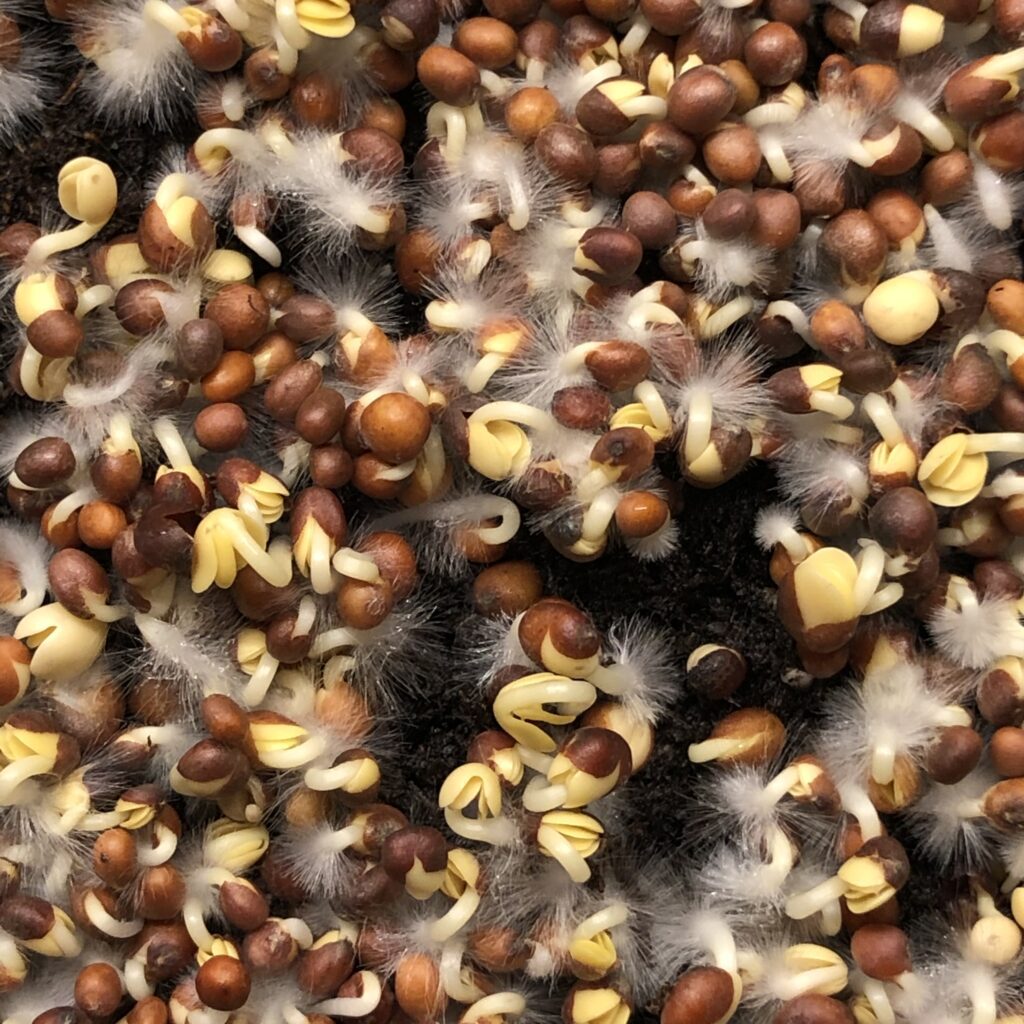
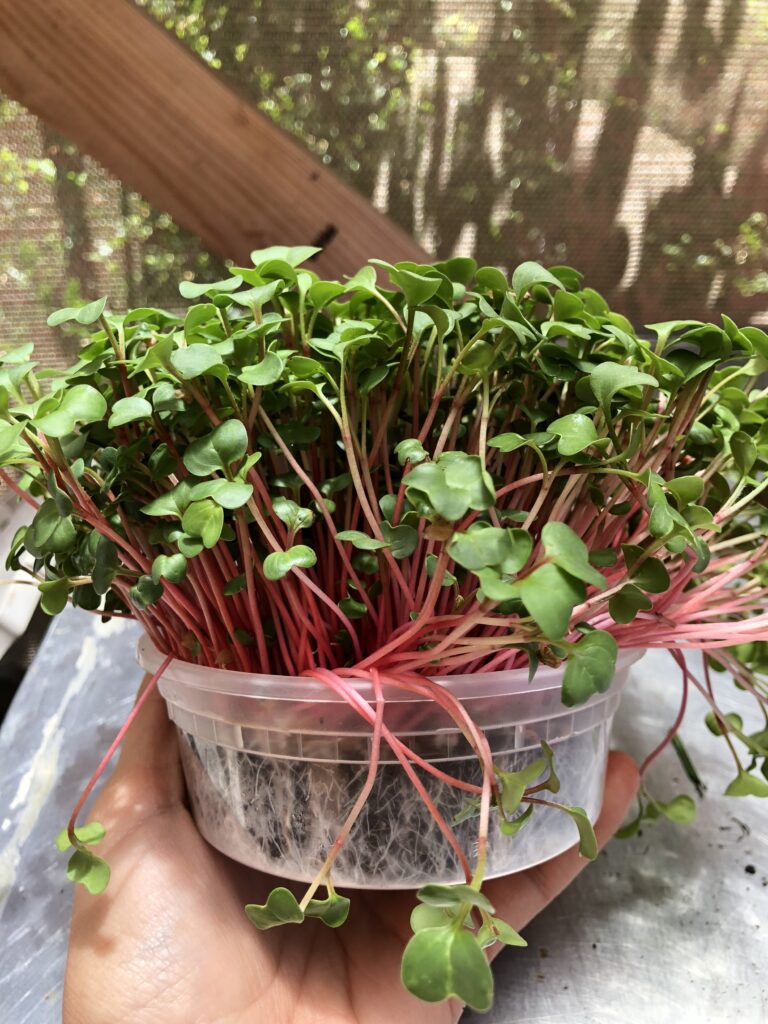
Root hairs look like tiny little fuzzy hairs growing from the exposed roots of your microgreens. In the picture below, you can see the hairs all growing out of broccoli microgreens. The hairs are distinct and growing in the same direction (out from the root).
Root hairs are a part of the root system, reaching out looking for water and nutrients to deliver to the growing plant. At first glace, the root hairs may be so dense that they look like microgreens mold.
Root Hairs Are Not Mold.
Use “The Watering Trick” To Figure Out If Your Microgreens Have Root Hairs Or Mold
There is a simple trick to figure out if that scary white fuzzy stuff that seems to be growing in your tray of microgreens is actually natural root hairs. Spray or gently water your microgreens from the top. If they are root hairs, the the white fuzzy look will disappear.
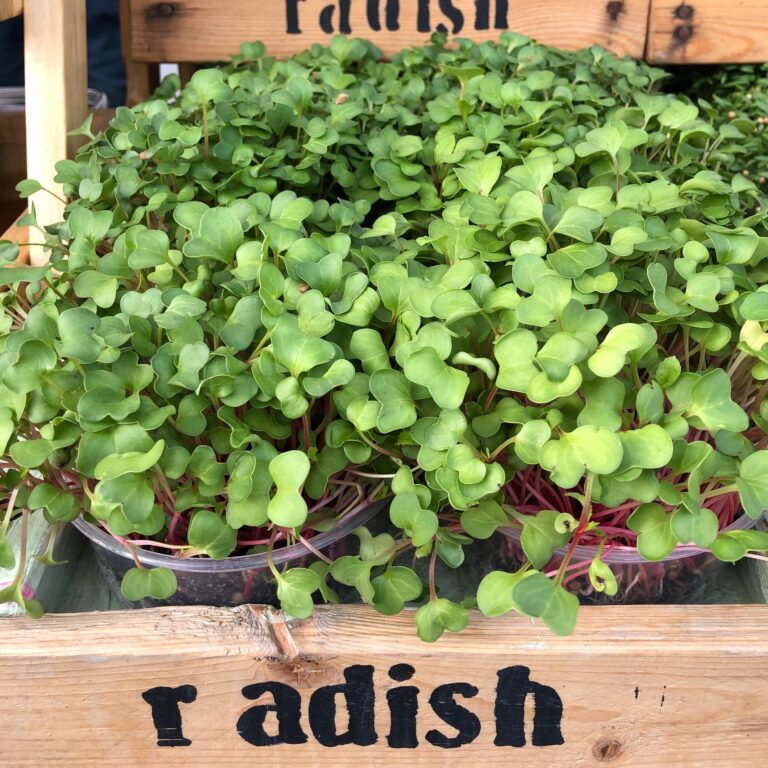
The photo below is the same tray of broccoli microgreens shown above, right after I watered from above. As you can see, the white fuzzy root hairs are no longer visible. Note: If you water from the bottom of the tray and do not actually wet the root hairs, they will not disappear. So go ahead and make sure you get them wet to see them disappear.
Actual Mold v. Root Hairs In Your Microgreens
Sometimes, you will get microgreens mold or fungi on your microgreens. You can determine if something is mold by examining it.
Check Out This Example Of Microgreens Mold vs. Root Hairs
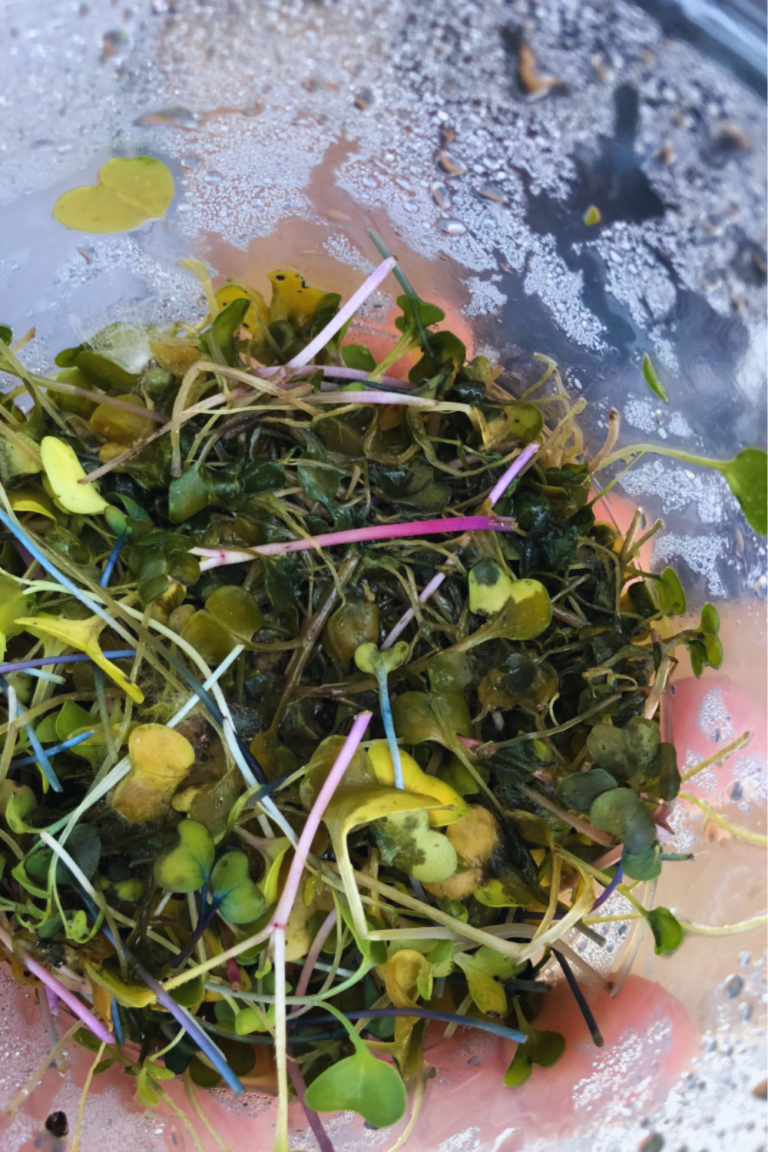
Look at the picture below. This is a picture of red cabbage microgreens. It is easy to see that this funk is not root hairs after watering. Compare the actual mold to this image for red cabbage microgreens with root hairs.
What If I Still Can’t Tell If It’s Root Hairs Or Microgreens Mold?
Don’t fret if it is not immediatly clear whether you have some kind of uninvited mold, Wait a few more days and it will usually become clear. Mold will grow and your microgreens will look sicker. IF it is root hairs, you will not see the white mass increase in size and your plants will look healthy.
Does it look like cotton?
Picture a fluffy cotton ball, or cotton that has been stretched out. Longish threads tangled together spreading over multiple microgreen stems are evidence that your tray has been compromised. If it is in a small area, you can try to dig it out and hope it doesn’t spread. Give your remaining microgreens plenty of fresh, gently moving air.
Is it covering more than one microgreen stem?
If the funny looking mass of white stuff is covering more than a couple microgreens, there is a good chance it is mold. You can try to dig it out and hope it doesn’t spread. Give your remaining microgreens plenty of fresh, gently moving air.
What stage of growth are you at?
If you microgreens are very young and just emerging from the seed, it is more likely you are seeing root hairs. If your microgreens are full grown, and you see white fuzzy stuff barely showing where the stem meets the soil (or growth mat), it still could be root hairs showing.
However, if the white fuzzy mass is above the soil line and growing up the stem of full grown microgreens, it is likely mold. Try the watering trick to see if it disappears.
Are the stems or roots looking unhealthy or turning brown?
I sell nearly all of my living trays in translucent recyclable plastic trays (The Grow You Own Kit uses the same clear trays to grow). One reason for that is so you can see the health of the roots. Take a look at bottom of the tray to see the roots. Do the roots directly below the white fuzzy growth look healthy? Are they white, tan or creamy colored or are they dark brown and decayed. Sick looking roots may be caused by a microgreens mold or fungus on the tiny plant. Also look for root density. If your micros are full grown, or nearly full grown, the roots should be tangled and robust and matted together.
If your micros are still fairly young, look to see if the roots are growing evenly through the entire tray. If you see a bald spot where you’d expect to see roots, or if the roots seem spindly and sparse, it can be an indication that your microgreens are struggling. Struggling and stressed out microgreens are more likely to succumb to mold, and mold is more likely to cause your microgreens to become too stressed out and sick.
If you don’t grow in translucent plastic trays, you still might be able to pop the microgreens out of the tray and look at the roots. Use your best judgment. The more mature the microgreens, the more likely you can safely pop the entire root mass out of its tray
Personally, I do not eat moldy microgreens, but I will eat the microgreens grown in the same tray that do not have any moldy patches— depending on how early I catch the problem.
If you are concerned about food borne illness such as e-coli or salmonella, looking for mold or fungus is not an indication of whether your microgreens are contaminated. Those pathogens are not going to be visible to the naked eye.
The More You Grow Microgreens, The Better You’ll Be At Identifying Root Hairs
Root hairs are not microgreens mold or fungus. They are a natural part of a healthy root system. Marvel nature and enjoy eating and growing microgreens.

Thank you for this post. I am here after seeing a fuzzy patch in my flaxseed tray (day 2) , which disappeared after I sprayed water . I am glad that it was just root hair .
Great post. Glad there is some good information out there. If anyone looking to stay connected check out my: Ohio Microgreen buy and sell group.
https://www.facebook.com/groups/249205379832802/
No pathogenic mold
Stick to the plant roots
Provides the plant with nutrients
Mycorrhizal fungi
thats not root hairs. thats a stage of mycelium growing. Use your noggin ppl. They need air, water, light, and soil to grow in. all these combined should not have mold. or you just need more research into what youre doing rather than; omg i love thaaaatt. im doing ittt. just throws shit together. eats mold. doesnt last, too much work. im done aka typical millenial
You have a lot of ideas on this subject. I’ve been growing and selling microgreens professionally for several years and do enjoy reading research and articles about the nuances and science of microgreens. If you have any peer-reviewed articles you’d like to send my way, I’d be happy to dig in.
Also, I am not a millennial, no need to make assumptions. Even if I was a millennial, there is no need to stereotype a large group of people. I’d appreciate kindness in all comments on this site. If you become aggressive or unkind, I will use my discretion to remove your comments.
WOW!
R&D needs to chill!!
Harsh words for a microgreens forum?
Take it down a notch, butthead
Thanks for your support! I had totally missed R&D’s comment, but now I’ve had the chance to respond.
what are your feelings about spraying the microgreens with a solution of water and hydrogen peroxide to kill/inhibit mould growth? I’ve read that 500ml of water with a tsp of 3% hydrogen peroxide solution can help keep the growth down?
I’ve experimented with peroxide in the past. I didn’t see much difference in my grow with peroxide. Now, I do microgreens (sun and soil) exclusively and no traditional sprouts and no recirculating water. With sprouts growing (water only growing), you’ll certainly want to take measures to minimize potential pathogens.
I think seed quality really matters for mold and air flow is key. Even with both of those, I still find certain times of the year just are not ideal for some varieties and mold happens.
Seriusly!!!!! This helped me so much, I had root hairs on the last time that I thought was mold, threw it out. Had them again on this one and I was so bummed, I thought I was a killer! Turns out they are root hairs and I am not a killer, you saved my micro greens. Forever appreciating you.
This is our 4th go around with sprouting broccoli seeds and we couldn’t figure out why they are always getting mouldy on day 3 or 4! I just happened to google if I can rinse the mold off and still eat them-when I ran across your article. Thank You Jesus!!!! I am so relieved to know that we are not doing something wrong!!!
Yay! So glad it help! Hope those broccoli micros are nourishing and delicious.
Have no trouble with any microgreen going mouldy except large pea seeds. No matter what base I use, hemp, coconut coir, soaking in advance, they aways start to mould after day 3 and rot.
Even using same seeds from different package.
Cannot figure this seed out.
Sounds like a mystery. Have you tried changing where you grow them? Like moving them outdoors, or to a different room? Perhaps bottled water? Seems like there might be a microorganism that is going unchecked that only attacks peas, maybe a new environment will have a more balanced environment that can keep whatever mold agent in check. But if you eventually figure it out, I’d love to hear what you did.
Very helpful! My first tray of broccoli might have been root hairs I threw out
I just started my very first trays of microgreens and almost threw them out when I saw the white fuzz. But I thought I would just keep growing as a practice, since I don’t have any idea what I’m doing. So happy I found this article before I did anything drastic.